
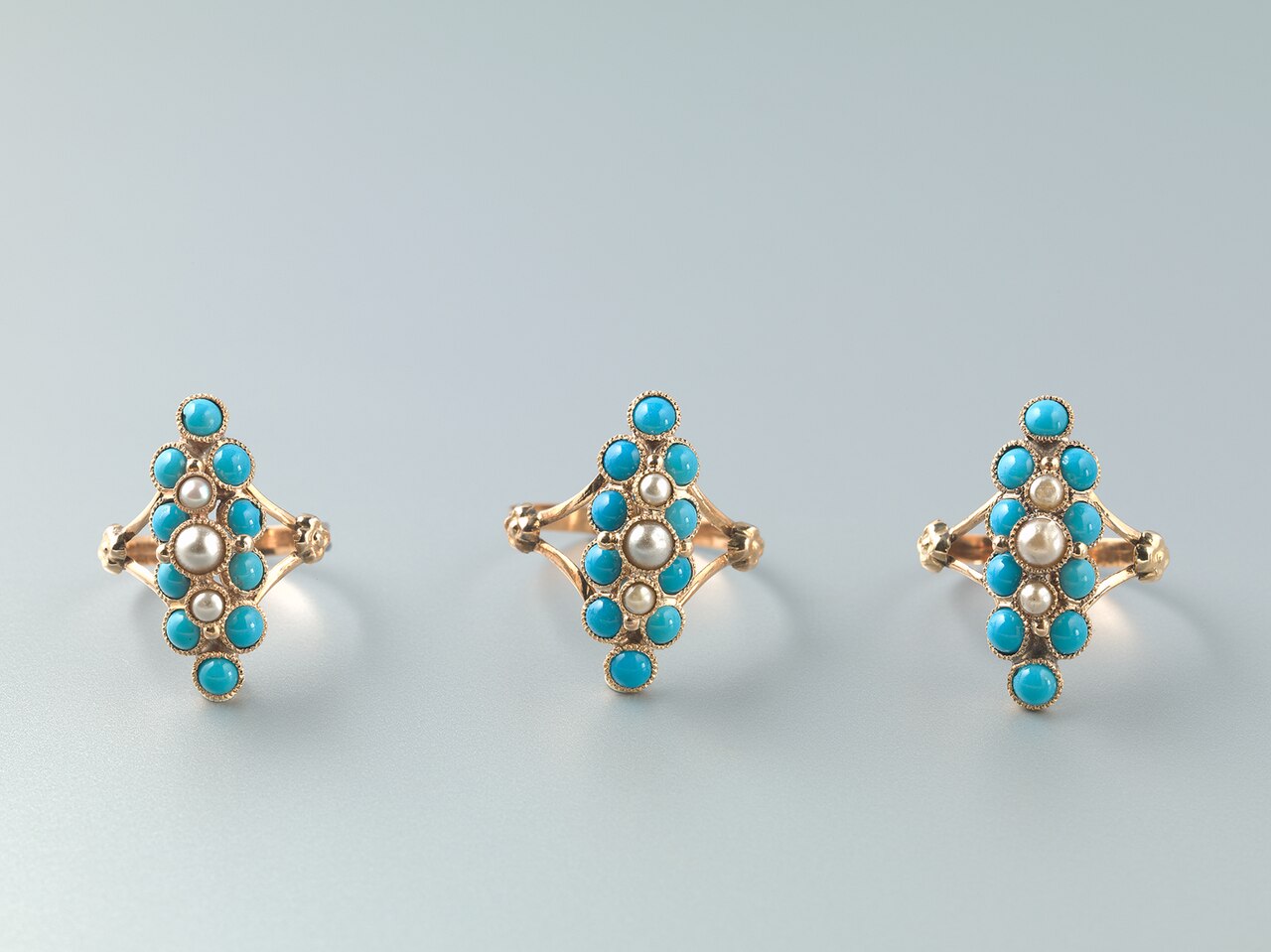
Vintage-style rings borrow details from specific eras. Knowing the vocabulary makes it easier to describe what you like and to judge an antique ring’s condition.
“Vintage” covers a century and a half of design. A Victorian cluster ring, an Edwardian platinum filigree ring and an Art Deco emerald cut with baguettes have little in common except age. Knowing the eras and their signature details helps you describe what you like to a jeweler, search more precisely and judge an older ring’s condition.
The main eras at a glance
| Era (approximate) | Signature details | Typical stones and metals |
|---|---|---|
| Victorian (1837 to 1901) | Clusters, sentimental motifs, closed-back settings | Old mine cuts, rose cuts, colored stones; yellow and rose gold |
| Edwardian (about 1901 to the 1910s) | Lacy filigree, milgrain, bows and garlands | Old European cuts, pearls; platinum |
| Art Deco (1920s to 1930s) | Geometric lines, symmetry, contrasting colors | Step cuts, baguettes, calibré-cut sapphires and emeralds; platinum and white gold |
| Retro (1940s) | Bold, sculptural forms | Larger gold mounts, rose and yellow gold |
Era dates are approximate, and styles overlapped. Many rings also mix details from different decades.
Details worth knowing
- Milgrain. A line of tiny metal beads along an edge, made with a small wheeled tool. It gives a soft, finely finished outline.
- Filigree. Openwork metal patterns, often lace-like, especially in Edwardian and early Art Deco rings.
- Hand engraving. Scrolls, leaves and other patterns cut into the band or shoulders. See the engraving guide for engraving methods.
- Calibré-cut stones. Small colored stones cut precisely to fit a channel or outline, common in Art Deco rings.
- Cluster settings. Several small diamonds grouped to look like one larger stone, common in Victorian rings and an ancestor of the modern halo; see the halo guide.
- Toi et moi. A two-stone ring, with the stones side by side, popular in several eras.
- East-west settings. An elongated stone set across the finger rather than along it.
Old cuts
Diamonds cut before modern brilliant standards were shaped by hand:
- Rose cuts have a flat base and a domed top covered in triangular facets, giving a soft glow rather than sparkle.
- Old mine cuts are cushion-shaped, with a high crown, small table and often an open culet.
- Old European cuts are round, with large facets and often an open culet, an early relative of the modern round brilliant.
These cuts give a softer, chunkier sparkle that many people prefer. Our diamond shapes guide compares them with modern shapes, and step-cut diamonds covers the emerald and Asscher cuts beloved in Art Deco design.
Buying an antique ring
Careful: Ask a jeweler to inspect an antique ring before you buy it, or make the sale conditional on an inspection. Age shows in places that are easy to miss in photos.
What the inspection should cover:
- Prongs and stone security. Worn prongs are common in old rings.
- Shank thickness. Decades of wear thin the band at the bottom, and many antique rings have been resized several times.
- Milgrain and engraving. These soften with wear and can be refreshed, but restoration should respect the original work.
- Stone condition. Old diamonds often have chipped girdles or worn facet edges.
- Treatments. Older colored stones may have been oiled or filled; see gemstone treatments.
Reinforcing a thin shank or rebuilding prongs is normal and does not spoil an antique ring’s character.
Vintage-style rings
Many new rings borrow vintage details, such as milgrain edges, filigree galleries and engraved shoulders, with modern construction and modern or old-cut stones. They suit someone who loves the look but wants a new ring with a known history. The underside of a ring, its gallery and shoulders, is where much of the vintage detail lives; see ring anatomy.
If you have an inherited old-cut diamond, a vintage-style mounting can be a natural home for it. The guide to resetting an heirloom stone explains what to check first.
Quick notes
- Edwardian rings are known for lacy platinum filigree and milgrain; Art Deco rings for geometric lines, step cuts and contrasting colors.
- Old mine and old European cuts give a softer, chunkier sparkle than modern round brilliants.
- Antique rings may have worn prongs, thin shanks or softened milgrain, so a jeweler’s inspection is part of buying one.
- Vintage-style rings are new rings that borrow these details with modern construction and stones.
Common questions
Q: What is the difference between antique, vintage and vintage-style?
A: In the trade, antique usually means about 100 years old or more and vintage means an older piece that is not yet antique. Vintage-style or vintage-inspired describes a new ring designed with older details.
Q: What is milgrain?
A: Milgrain is a row of tiny metal beads along an edge, made with a knurling tool. It softens the outline of a ring and is common in Edwardian and Art Deco designs.
Q: Are antique rings durable enough for everyday wear?
A: Many are, after a jeweler checks and repairs them. Thin shanks, worn prongs and delicate filigree may need reinforcement, which a good jeweler can do while keeping the ring’s character.
Q: Can I get a modern diamond in a vintage-style setting?
A: Yes. Many vintage-style mountings are designed for modern round or step-cut diamonds. Others are made to suit old European or old mine cuts, which sit a little differently.