
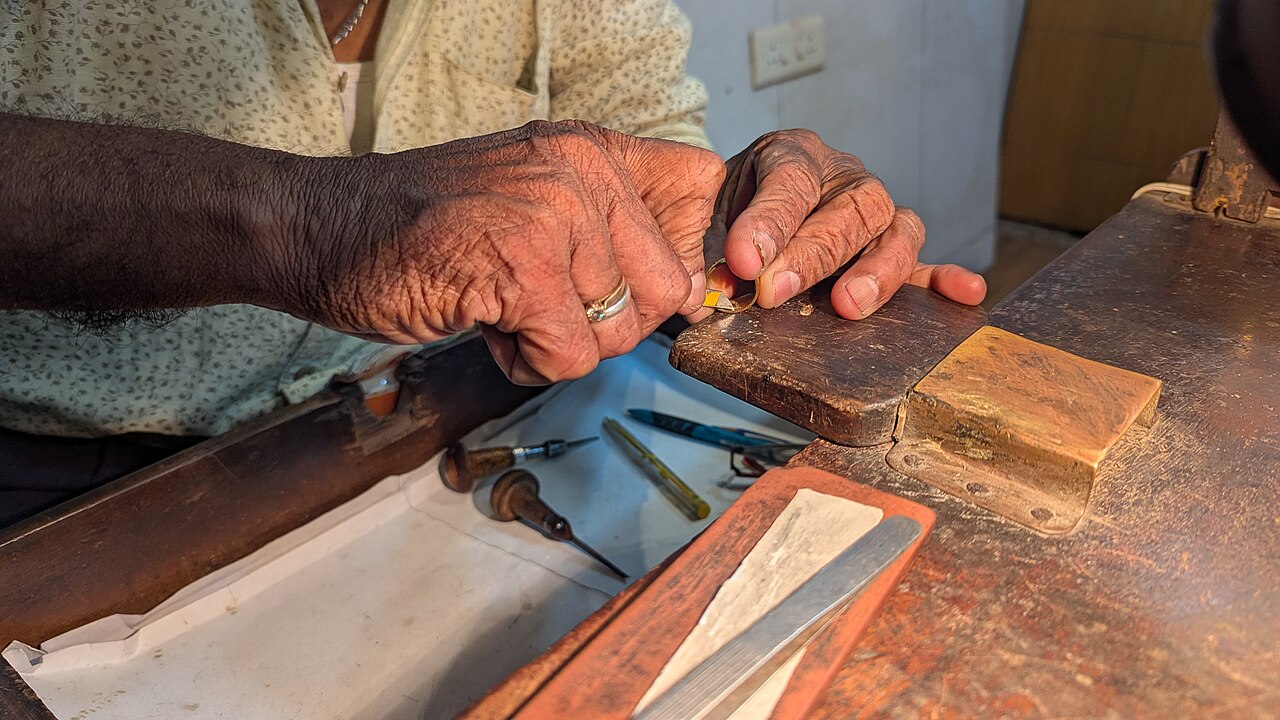
Engraving is usually the last step in making a ring and the most personal. A few practical details decide whether it stays legible for decades.
A few words inside a ring can mean more than the stone on top of it. Engraving is simple to order, but placement, method and length all affect how it looks and how long it lasts. Here is what to decide before you send the text.
Where engraving can go
| Placement | Visibility | Notes |
|---|---|---|
| Inside the band | Private | Most common; protected from wear |
| Outside the band | Visible | Patterns or text; wears faster |
| Under the head or on the gallery | Hidden | A small detail only the wearer knows about |
| Side of the band | Visible from the side | Often decorative patterns on vintage-style rings |
Outside engraving is often decorative rather than text, such as scrolls or leaves on vintage-style bands; see vintage ring details.
Engraving methods
- Hand engraving uses a sharp steel tool called a graver to cut the metal. It gives depth and a traditional, slightly irregular character, and the results depend on the engraver’s skill.
- Machine engraving uses a rotating or diamond-tipped tool guided by a machine. It is consistent and common in jewelry stores.
- Laser engraving marks the metal with a focused beam. It handles very small text, many fonts and images such as handwriting or fingerprints. It is the standard for very hard materials such as tungsten carbide and ceramic, which are popular for men’s bands; see the men’s wedding band guide.
How much will fit
The limit depends on three things:
- Ring size. Larger rings have more inside circumference.
- Band width. Thin bands leave room for only one small line.
- Font. Script fonts need more space than block letters for the same text.
Retailers usually state a character limit, and spaces and symbols count. If a phrase does not fit, shorter versions often read better anyway: initials and a date, or a single word.
Resizing and engraving
When a ring is resized, the jeweler usually cuts and adds or removes metal at the bottom of the band. Engraving across that area can be cut through or distorted. Centering the text toward the top half of the band, under the stone, keeps it safer if the ring is resized later. Our guide to which rings can’t be resized explains how sizing works.
Careful: Engraved rings are often final sale. Ask for a written proof showing the exact text, font and placement, and check spelling, names and dates before approving it.
Fonts and legibility
Inside a ring, the curve and small size make some fonts hard to read. Simple block or serif fonts stay clear at small sizes, while elaborate scripts can blur together on a thin band. If you love a script, keep the text short. On comfort-fit bands, which are rounded inside, text is placed on the curve, which slightly limits height.
Ideas that age well
- Initials and the wedding or engagement date
- A date in Roman numerals
- Coordinates of a meaningful place
- One word or a short phrase that means something to both of you
- A handwritten word or signature, laser engraved from a sample
- A fingerprint image, laser engraved
Avoid jokes that might not read well in twenty years and anything you would mind a jeweler, appraiser or future owner reading.
Timing
Engraving is usually added at the end, after sizing and finishing. In a custom ring it is part of the final stage described in how a custom engagement ring is made. For a wedding band that will be worn with an engagement ring, decide on engraving after checking how the two rings sit together; the guide to pairing a wedding band covers fit.
Quick notes
- Inside the band is the most common place for engraving; outside engraving and hidden spots under the stone are also options.
- How much fits depends on the ring size, the band width and the font, so ask for the limit before choosing words.
- Engraving near the bottom of the band can be lost if the ring is resized later.
- Many retailers treat engraved rings as final sale, so check spelling and dates on a written proof.
Common questions
Q: How many characters can fit inside a ring?
A: It varies with the ring size, band width and font. Thin bands in small sizes fit the least. Retailers usually state a limit, and spaces and symbols count as characters.
Q: Can tungsten and ceramic rings be engraved?
A: Yes, usually with a laser. These materials are too hard for most hand tools, which is one reason laser engraving is standard for them.
Q: Will engraving wear off?
A: Engraving inside the band lasts well because it is protected from most contact. Shallow engraving on the outside of a band wears faster, especially on softer metals.
Q: Can engraving be removed or changed?
A: Sometimes. A jeweler can often polish out shallow engraving, but this removes metal, and deep engraving on a thin band may not leave enough metal to do it safely.