
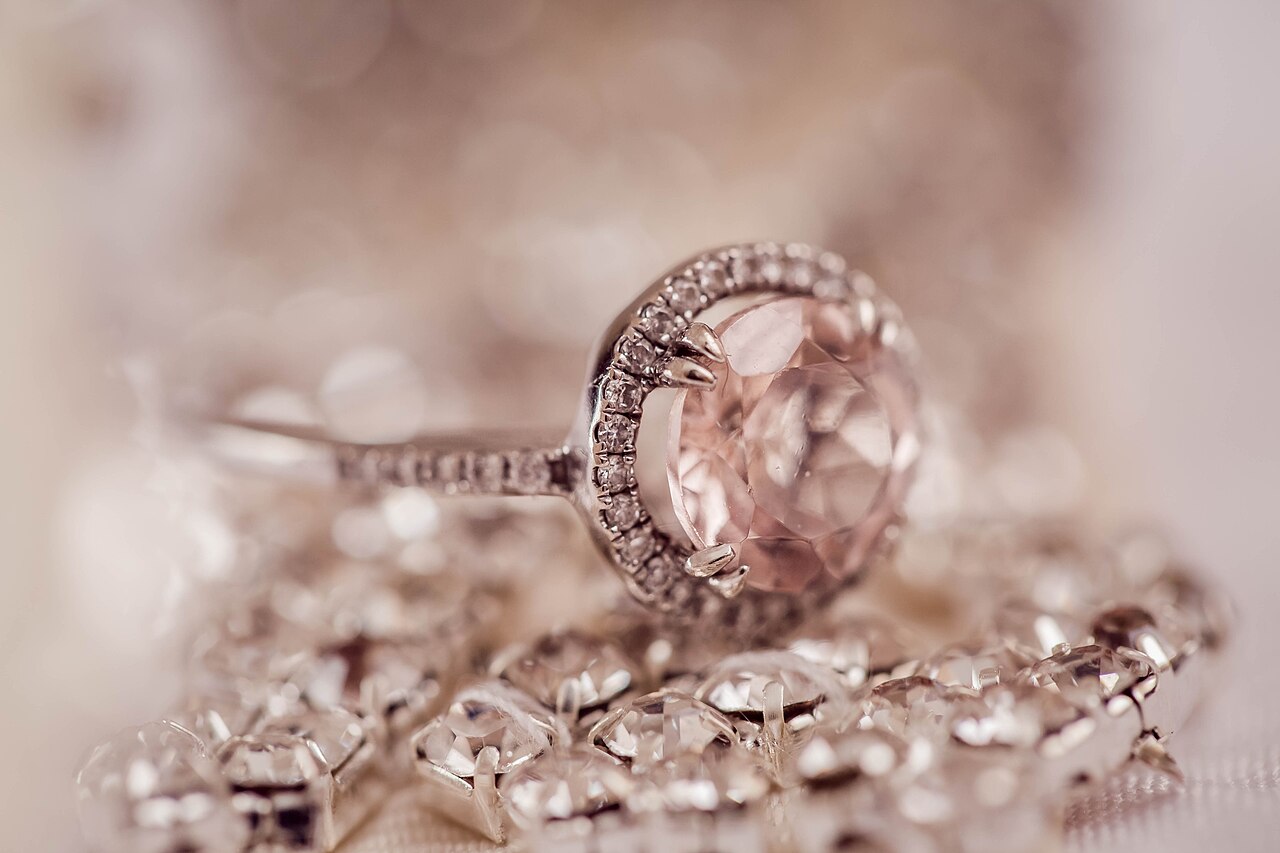
A halo can make a modest center stone look bigger and brighter. It also adds dozens of small stones, and each one deserves a little thought.
A halo is a ring of small stones set around the center stone. It became one of the most popular engagement ring styles because it delivers a lot of sparkle and visual size without a larger, much more expensive center diamond. Whether it is the right choice depends on taste, budget and how much upkeep the wearer is happy with. For a comparison with other styles, see engagement ring settings compared.
Halo styles
| Style | What it looks like | Good to know |
|---|---|---|
| Classic halo | One row of small diamonds following the center stone’s outline | Most common; works with every shape |
| Double halo | Two rows of small stones | More size and sparkle, more stones to maintain |
| Hidden halo | Small stones under the center stone, visible from the side | Top view stays like a solitaire |
| Contrast halo | Halo in a different shape, such as a cushion halo around a round | Changes the ring’s outline |
| Colored halo | Sapphires or other colored stones around a diamond, or diamonds around a colored stone | Adds color; check durability of the halo stones |
| Vintage or floral halo | Halo with scalloped edges, milgrain or petal shapes | Often paired with old cuts; see vintage ring details |
Why a halo looks bigger
From across a room, the eye reads the halo and the center stone as one bright shape. A center stone surrounded by a halo can therefore look closer to a larger solitaire, which is why halos are often suggested in budget discussions. Our budget guide covers other ways to get more visual size for the money.
Up close, the center stone is still its true size. The halo also changes the ring’s outline: around an elongated stone, a halo stretches the shape further, which makes the ratio covered in length-to-width ratio even more visible.
Judging the small stones
Small diamonds in halos and pavé bands are usually not graded individually, but they still vary in quality. Ask:
- What color and clarity range are they? They should look close to the center stone in color, or the halo can look tinted beside it.
- Are they natural or laboratory-grown? A seller should disclose this, and laboratory-grown stones must be described with a qualifier.
- How are they set? Halo stones are usually held by tiny beads or shared prongs of metal. Fine, even metalwork with every stone level is a sign of careful setting.
Upkeep
Every small stone is held by very small amounts of metal, which wear just as prongs do. Halo rings benefit from a quick inspection under magnification once or twice a year, the same schedule many jewelers suggest for prongs; see prong settings explained. Dirt and lotion also collect under halos and dull the sparkle, so regular gentle cleaning makes a visible difference.
Careful: If you notice an empty spot in the halo, keep the ring in a box until it is repaired. Once one small stone is gone, the metal holding its neighbors is often weakened too.
Wedding bands and resizing
Because a halo usually sits low and wide, a straight wedding band often cannot sit flush against it. Curved and contoured bands are the usual solution, and some people like the small gap a straight band leaves. The options are covered in pairing a wedding band.
Halo rings often come with pavé bands, which limit resizing. A band with stones only across the top can usually be sized through the plain lower section, while stones all the way around may rule resizing out. See which rings can’t be resized.
Is a halo right for you?
A halo suits someone who loves sparkle, wants visual size and does not mind a little more maintenance. A solitaire or hidden halo suits someone who prefers a cleaner top view or wants the simplest pairing with a band. Trying both on, even in a store with sample rings, usually settles it quickly.
Quick notes
- A halo frames the center stone with small diamonds, which makes the bright area of the ring larger from a distance.
- Hidden halos sit under the center stone and show mainly from the side, so the top view stays a classic solitaire.
- Ask about the color and clarity of the small stones; they should be close enough to the center stone that the ring reads as one piece.
- Halos usually need a curved band or a small gap beside a wedding band, and small stones should be checked regularly.
Common questions
Q: Does a halo really make the diamond look bigger?
A: It makes the whole bright area larger, so from a distance the ring reads as a bigger stone. Up close the center stone is still its own size, and some people prefer the cleaner look of a solitaire.
Q: Can a halo be added later?
A: Often, yes. A jeweler can move the center stone into a new halo mounting, or design a halo that fits around the existing setting. Compare the cost with buying a halo setting from the start.
Q: What is a double halo?
A: It is two concentric rings of small stones around the center stone. It adds even more sparkle and size, along with more stones to maintain.
Q: Are halo stones usually natural diamonds?
A: They can be natural, laboratory-grown or another gem entirely. A seller should tell you what they are, and lab-grown stones must be described with a qualifier such as laboratory-grown.