
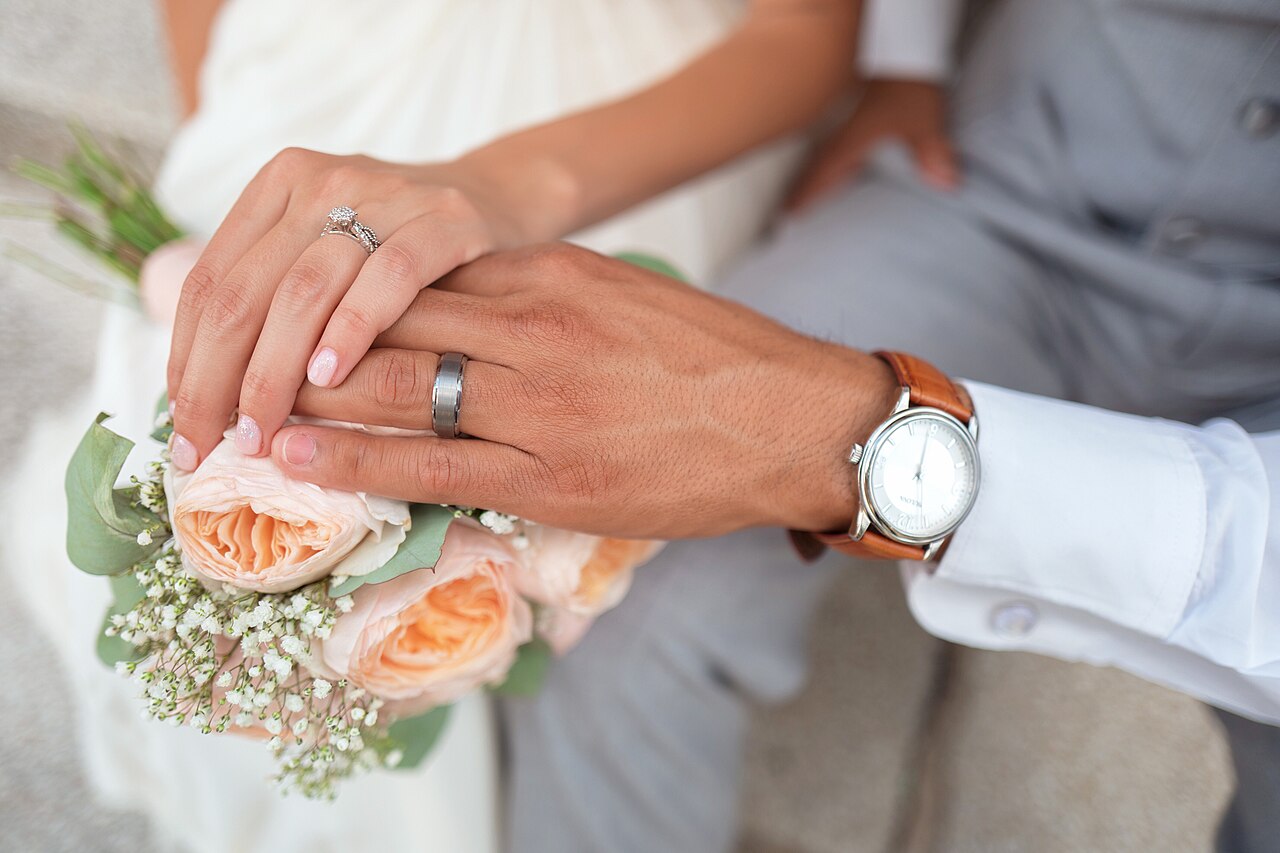
Most engagement rings are worn with a band for decades. Thinking about the pair early saves a lot of compromises later.
An engagement ring chosen on its own sometimes turns out to be hard to pair. A halo might push a straight band away, leaving a gap, or a low-slung pear might collide with any band at all. The good news is that almost every engagement ring can be paired with something. It is just easier when you know the options in advance.
Flush fit, gap or contour
| Fit | What it looks like | Works best with |
|---|---|---|
| Flush | Straight band touches the engagement ring along its length | Low settings with an open space under the stone, plain or pavé shanks |
| Gap | Small space between the band and the engagement ring | Wide heads, halos and cathedral settings |
| Contoured or curved | Band curves around the head | Halos, pears, marquise, three-stone heads |
| Notched | Straight band with a cut-out where the head sits | Bezels and wide baskets |
| Stacked | Two or more bands, sometimes on both sides | Solitaires with simple shanks |
Whether a straight band sits flush comes down to what is directly below the center stone. If the head sits low and the gallery or halo extends down to the band, a straight band will be pushed away. A ring designed for flush fitting usually has a raised head and space under it for the band to slide in. The guide to ring anatomy explains galleries and shoulders.
Setting styles and what they need
- Solitaires on a plain or thin pavé shank are the easiest to pair. Most straight bands work, as long as the head is high enough.
- Halos often need a curved band or a gap, because the halo sits as low as the band. A hidden halo, set below the center stone, is the exception. See the halo guide.
- Three-stone rings have a wide head, and side stones that sit low often call for a contoured band.
- Bezels sit low and wide, so a notched band or a gap is common.
- East-west settings, where an elongated stone lies across the finger, often need a contoured band or a small gap.
Metal and color
Matching metals is the simplest way to make the pair look intentional over the years. White gold that has been rhodium plated can look different from platinum as the plating wears and the platinum develops a patina, and a harder metal rubbing against a softer one can gradually wear the softer ring where they touch. The comparison of platinum and white gold explains how each metal ages.
Mixed metals can work well too, for example a yellow gold band beside a platinum engagement ring, when the contrast is deliberate.
Width and profile
A band the same width as the engagement ring’s shank gives an even look. A thinner band keeps attention on the engagement ring, and a wider band creates a bolder stack. Profiles matter as well: a rounded (comfort-fit) band beside a flat-edged shank can look mismatched, so compare the two from the side.
Good to know: Take the engagement ring with you when you try bands on, or ask the jeweler to bring the engagement ring’s exact mounting from stock. Seeing the pair from the top and the side is the only reliable test.
Pavé and eternity bands
Diamond bands are a popular pairing, but stones set all the way around a band limit resizing, and two diamond bands rubbing together can wear each other’s small settings. A half-eternity band, with stones across the top only, avoids both problems. Our guide to rings that can’t be resized explains the limits.
Should the rings be soldered together?
Some couples have the engagement ring and band soldered after the wedding. The rings then stay aligned, stop spinning and stop rubbing against each other. The downside is that the pair becomes one piece: you cannot wear the engagement ring alone, and any repair or resizing involves both. It is easy to have the solder cut later, so it is not a permanent decision.
When to plan the band
You do not have to buy the band with the engagement ring, but it helps to know a compatible band is possible. If you are commissioning a ring, mention the band in the brief; the custom ring process explains when that design decision is made.
Quick notes
- Whether a straight band sits flush against an engagement ring depends mainly on how low the head sits and what is under the stone.
- Curved, contoured and notched bands are made to wrap around halos, wide heads and pointed shapes.
- Matching metals keeps the two rings the same color as they age and avoids a harder metal wearing a softer one.
- Bring the engagement ring when you try bands on, because a band that looks right alone can leave an awkward gap beside it.
Common questions
Q: Should the wedding band be the same width as the engagement ring?
A: Not necessarily. Many people choose a band the same width as the engagement ring’s shank so the pair looks even, but a thinner or wider band can also work. Try both on together before deciding.
Q: What if a gap between the rings bothers me?
A: A curved or notched band can close the gap, or a jeweler can sometimes lower the head of the engagement ring. Some people simply prefer the gap, which keeps the rings from rubbing.
Q: Can the two rings be soldered together?
A: Yes. Soldering keeps them aligned and stops them rubbing, but it fixes them as a pair. You can no longer wear one without the other, and resizing has to be done for both.
Q: Do I need to buy the band at the same time as the engagement ring?
A: No, but checking that a compatible band exists, or can be made, before choosing an unusual engagement ring avoids disappointment later.