
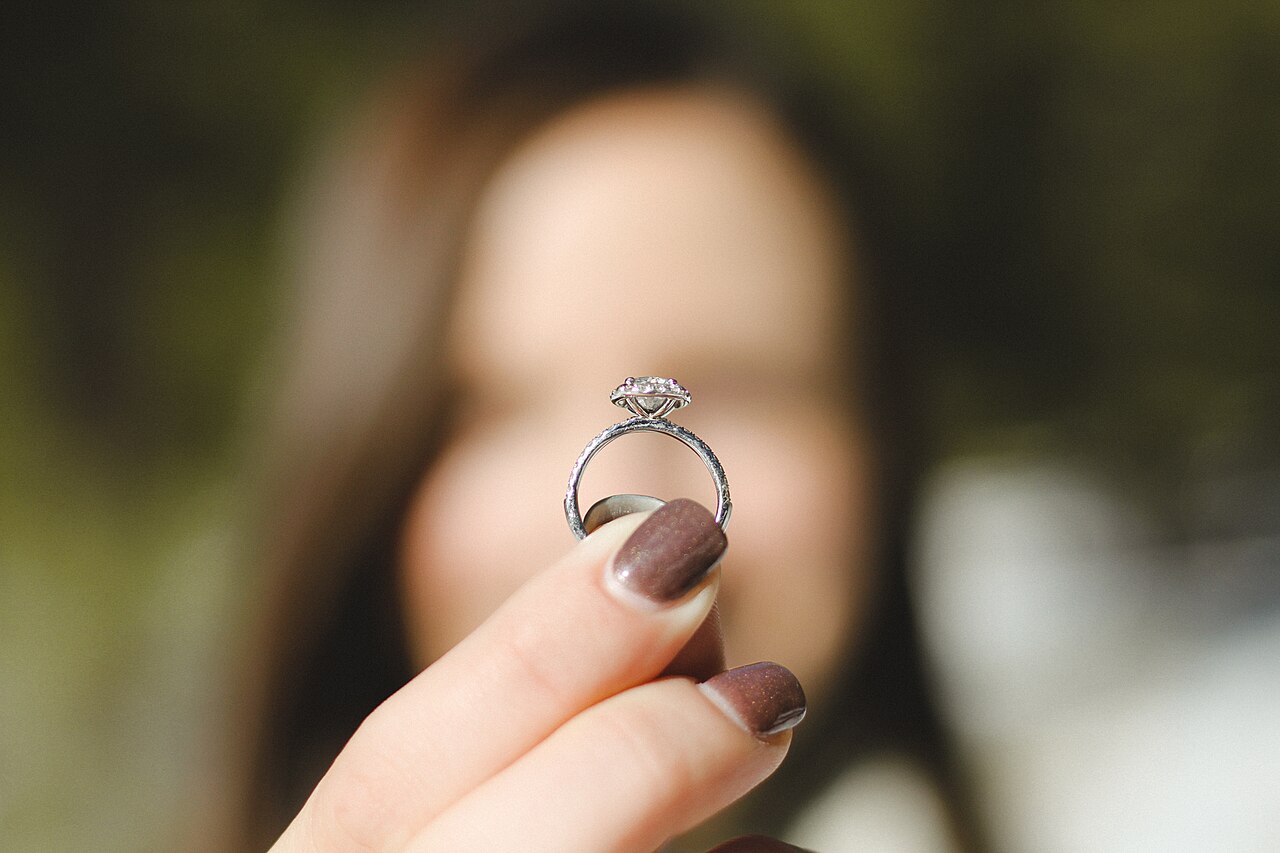
The setting decides how much of the stone you see, how it catches on sweaters and how much care the ring needs over the years.
Two rings can share the same center diamond and still look like different pieces of jewelry. The setting changes the outline of the ring, the amount of light that reaches the stone, the height it sits above the finger and the routine care it needs. Here is how the five most common styles compare, and the questions that usually settle the choice.
The five settings at a glance
| Setting | How the stone is held | Look | Everyday wear | Upkeep |
|---|---|---|---|---|
| Solitaire | One stone, usually prongs or a bezel, on a plain band | Clean, the stone is the focus | Depends on prong height | Prongs need periodic checks |
| Halo | Center stone surrounded by a ring of small diamonds | Larger, brighter face | Wider head can catch | Small stones can loosen |
| Pavé | Small diamonds set close together along the band | Continuous sparkle | Edges of the band take knocks | Small stones, harder resizing |
| Three-stone | Center stone with one stone on each side | Wider, balanced outline | Side stones sit exposed | Three sets of prongs |
| Bezel | Metal rim around the stone’s edge | Smooth, modern or vintage | Low snag risk | Little routine care |
Solitaire: one stone, nothing to compete with it
A solitaire is a single stone on a plain band. Most solitaires use prongs, which leave the sides of the stone open so light can enter from many angles. The style suits every diamond shape, and it is the easiest ring to pair with a wedding band because there is nothing at the shoulders to work around.
The details that change a solitaire are the number of prongs, the shape of their tips and the height of the head. Four prongs show a little more of the diamond, while six give a rounder outline and more contact points. Our guide to prong settings covers those choices in detail. A tall head makes the stone sit proud of the finger, which looks dramatic but catches more often on clothing and gloves.
Halo: a frame of small diamonds
A halo surrounds the center stone with a ring of small diamonds. Seen from across a room, the bright outline reads as one larger stone, which is why halos are popular with modest center stones. Halos also suit shapes with delicate points, such as pears and marquise cuts, because the frame adds some protection to the tips.
The trade-off is maintenance. Each small diamond in a halo is held by tiny beads or prongs of metal, and those can wear down or bend. A wider head also needs a curved band or a band set slightly apart. The halo guide explains hidden halos, double halos and how to judge the quality of the small stones.
Pavé: sparkle along the band
In a pavé band, small diamonds sit side by side with only tiny beads of metal between them, so the band looks paved with stones. Pavé can run halfway around the band or all the way around, and it is often combined with a solitaire head or a halo.
Because the stones cover the band, pavé limits resizing. A jeweler can usually adjust a half-pavé ring through the plain lower section, but a band set all the way around may not be resizable at all. The article on rings that can’t be resized lists the common limits.
Good to know: Ask how many small stones a pavé or halo ring has and how the jeweler handles a lost stone. Some retailers replace small diamonds as part of a service plan, and others charge per stone.
Three-stone: a wider, balanced outline
A three-stone ring sets one stone on each side of the center. The side stones can be the same shape as the center or a contrasting one, such as pear-shaped or tapered baguette side stones beside a round or oval. The result covers more of the finger and gives the ring a strong horizontal line.
The design works best when the side stones are in proportion to the center and close to it in color, so they read as a set. Our guide to choosing side stones walks through sizing and matching.
Bezel: metal all the way around
A bezel setting encloses the stone’s edge in a thin rim of metal. A full bezel goes all the way around, and a partial or half bezel covers two sides and leaves the others open. Bezels protect the girdle, the thin outer edge of the stone, which is the part most likely to chip in a knock. They also sit lower than most prong heads, which makes them practical for anyone who works with their hands. The guide to low-profile rings compares bezels with other low settings.
A bezel covers a sliver of the stone and blocks light from the sides, so the stone can look a little smaller than it would in prongs. A thin, well-finished bezel keeps that effect small.
Questions that decide between them
- How does the wearer use their hands? Frequent gym work, gardening or healthcare work favors lower, smoother settings such as bezels or low prongs.
- Which shape is the center stone? Pointed shapes need prongs or a bezel at the tips, and elongated shapes change how wide a halo or three-stone head becomes. See diamond shapes compared.
- Will the ring be worn with a wedding band? Settings with wide heads may need a contoured band. The guide to pairing a wedding band shows the options.
- How much upkeep is acceptable? More small stones mean more to inspect. A solitaire or bezel ring needs the least attention.
- Where should the budget go? Elaborate settings can cost as much as a modest center stone. Our budget guide suggests how to split the money.
Quick notes
- A solitaire shows the most of a single stone and pairs easily with almost any wedding band.
- Halos and pavé bands add sparkle through many small diamonds, and each small stone is one more thing to keep an eye on.
- Bezel settings wrap the stone in metal, which protects its edge and lowers the profile but hides a little of its side.
- Setting height, not only style, decides how much a ring snags and how a wedding band sits beside it.
Common questions
Q: Which setting makes a diamond look biggest?
A: A halo usually adds the most visual size because the ring of small stones extends the bright area around the center. Thin prongs and elongated shapes also help a stone look larger than its carat weight suggests.
Q: Which setting is most secure?
A: A full bezel holds the stone around its entire edge, so it is generally the most protective. A well-made six-prong setting is also very secure, as long as the prongs are checked for wear.
Q: Can a setting be changed later?
A: Usually, yes. A jeweler can move a loose stone or an existing center stone into a new mounting, although stones set in a halo or pavé band are reset individually and that adds labor.
Q: Do settings affect what wedding band will fit?
A: Yes. Low settings and plain bands often sit flush with a straight band, while halos, three-stone heads and some cathedral designs may need a curved or notched band.